The Petrodollar Explained Simply: How a 1974 Agreement Gave the Dollar Its Global Power for 50 Years
By Gabriel Arès · March 28, 2026 · 8 min read
Oil is the most traded commodity in the world. Yet even if you pay for gas in Canadian dollars in Quebec, in euros in Europe, or in yuan in China, the price of crude oil on the international market is almost always set in US dollars.
Why? Because for half a century, most of the world’s oil has been bought and sold in dollars. This is what we call the petrodollar system.
This quiet system gave the United States a considerable economic and geopolitical advantage. But how did it come about? It all starts with a crisis in 1971 and a key agreement in 1974.
1971: The Dollar Loses Its Gold Backing
After the Second World War, the Bretton Woods system made the dollar the world’s central currency. It was convertible into gold at a fixed rate.
In the 1960s and 1970s, the United States accumulated large deficits, particularly due to the Vietnam War and social spending. Foreign countries held more and more dollars and wanted to exchange them for gold.
On August 15, 1971, President Richard Nixon announced the end of the dollar’s convertibility into gold. This is known as the “Nixon Shock.” The dollar became a currency with no physical backing. Its value risked weakening and international confidence declined. The United States needed to find a new foundation to support their currency. The solution would come from oil.
1973–1974: The Oil Shock and the Agreement with Saudi Arabia
In October 1973, the Yom Kippur War broke out. Arab oil-producing countries imposed an embargo on exports to the United States and some of their allies. The price per barrel quadrupled in a few months. This was the first oil shock, triggering inflation and recession across the Western world.
It was in this context that US Secretary of State Henry Kissinger negotiated with Saudi Arabia.
On June 8, 1974, a framework agreement was signed in Washington between Kissinger and Prince Fahd bin Abdulaziz — the future king. Officially, it established joint commissions for economic and military cooperation. In practice, this agreement laid the groundwork for what would become known as the petrodollar system: Saudi Arabia agreed to sell its oil primarily in US dollars, while a large portion of the revenues — the petrodollars — would be reinvested in US Treasury bonds. In return, the United States offered military protection and sold modern weapons to the kingdom.
Other OPEC countries gradually followed suit. The dollar became the reference currency for global oil trade.
How Does Petrodollar Recycling Work?
The mechanism is simple but powerful.
All countries need oil. On the international market, the price of crude is set in US dollars. To import oil, countries must therefore obtain dollars. They pay exporters in dollars. The exporting countries receive these dollars — these are the petrodollars. A large portion is reinvested in American debt — Treasury bonds. This is called petrodollar recycling.
A concrete example: China sells products to the United States and receives dollars. It then uses those dollars to buy Saudi oil. Saudi Arabia places a portion of those dollars in American bonds.
The result: there is a constant demand for the dollar, even though the United States does not produce all the world’s oil.
The United States’ Exorbitant Privilege
Thanks to this system, the United States benefits from what economist Valéry Giscard d’Estaing called the “exorbitant privilege.”
They can finance their budget and trade deficits at low cost. They can issue more dollars without inflation immediately spiralling, because part of those dollars is absorbed by the rest of the world. The dollar remains the world’s reserve currency, which reinforces US influence — including through financial sanctions.
This system worked remarkably well for nearly 50 years, as oil remained indispensable.
What About Today?
The system is not dead, but it is gradually eroding. The BRICS are developing payments in local currencies, and the energy transition could reduce dependence on oil over the long term. For Canada and Quebec, this system has indirect links: the value of the loonie and our energy economy remain influenced by oil prices and the strength of the dollar.
Key Takeaways
- The petrodollar is not a currency, but the dollar received as payment for oil on the international market.
- It emerged after the Nixon Shock of 1971 — the end of gold convertibility — and solidified with the cooperation agreement between the United States and Saudi Arabia in 1974.
- The key mechanism is recycling: oil revenues are largely reinvested in American debt, creating permanent demand for the dollar.
- This allowed the United States to finance their deficits at low cost and maintain an exorbitant privilege for 50 years.
- Today, this system is showing signs of strain, but it remains dominant. Its evolution could have significant impacts on the global and Canadian economy.
References
- Federal Reserve History. (n.d.). Nixon ends convertibility of U.S. dollars to gold and announces wage price controls. https://www.federalreservehistory.org/essays/gold-convertibility-ends
- Investopedia. (n.d.). Understanding petrodollars: Definition, history, and global impact. https://www.investopedia.com/terms/p/petrodollars.asp
- New York Times. (June 9, 1974). Milestone pact is signed by U.S. and Saudi Arabia. https://www.nytimes.com/1974/06/09/archives/milestone-pact-is-signed-by-us-and-saudi-arabia-acclaimed-by.html
- U.S. Department of State, Office of the Historian. (n.d.). Nixon and the end of the Bretton Woods system, 1971–1973. https://history.state.gov/milestones/1969-1976/nixon-shock
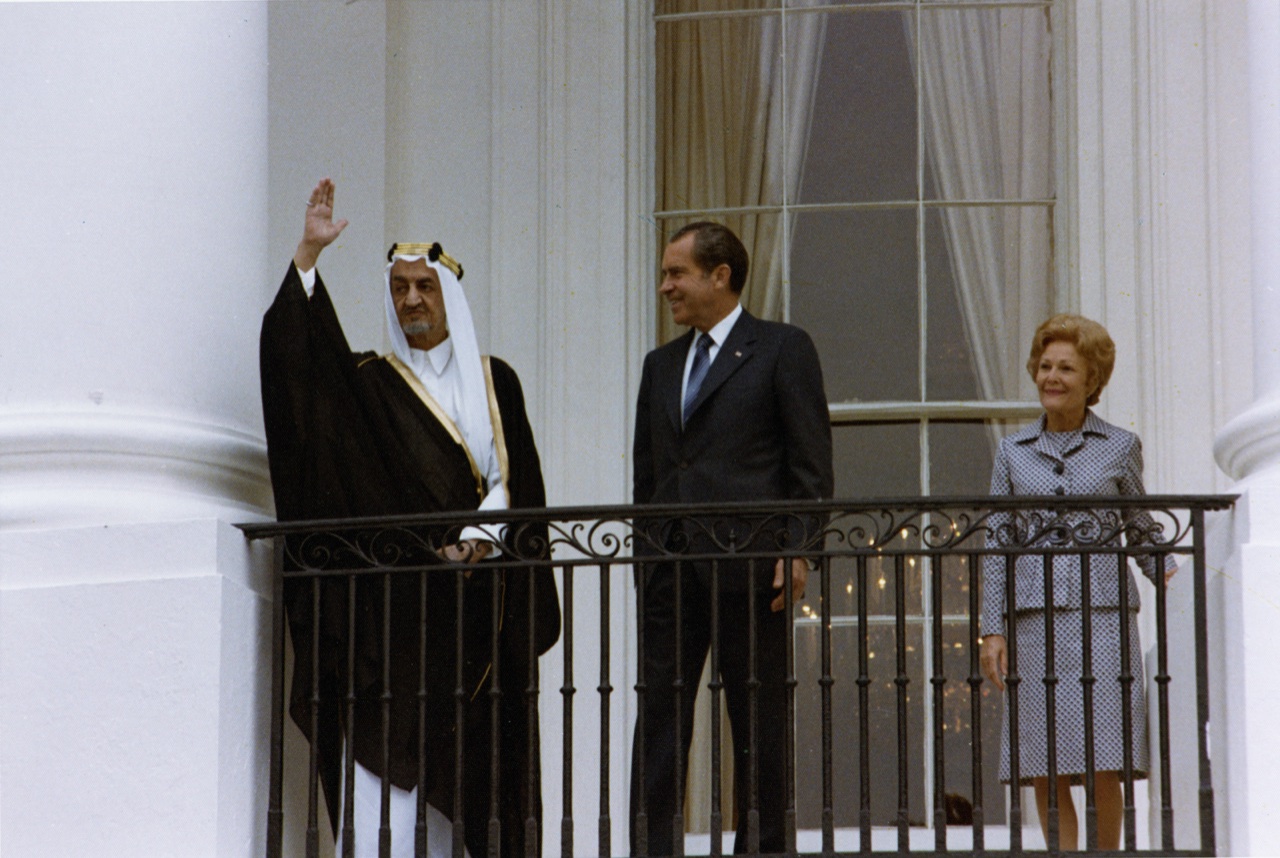
Image: President Richard Nixon and King Faisal of Saudi Arabia at the White House. Source: Nixon Presidential Library, public domain.