This article was generated by artificial intelligence and reviewed by Le Pivot's editorial team. We believe in transparency.
Hormuz Blockade Day 2: Tehran Cries Piracy as Crude Nears $105
By Le Pivot — Iran Monitor · April 13, 2026 · 10 min read
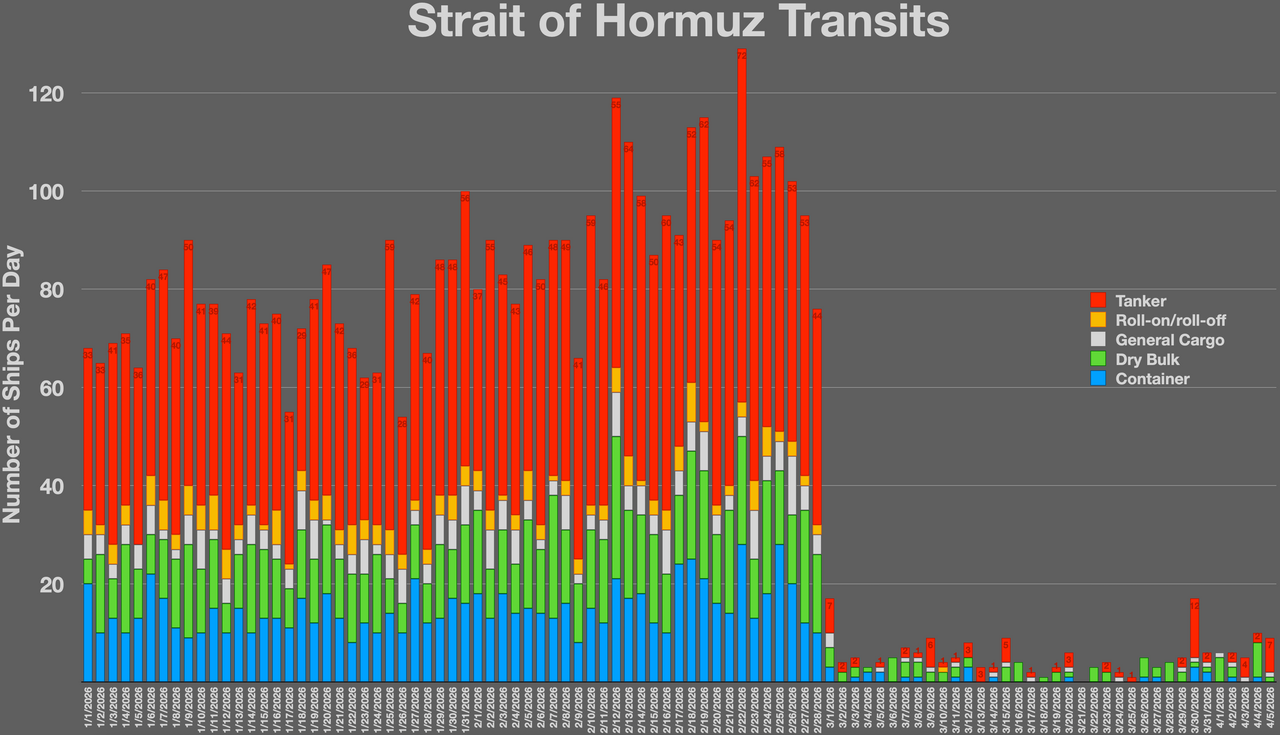
On April 13 at 10 a.m. ET, US Central Command (CENTCOM) forces began enforcing President Trump’s decree: a full blockade of all vessels entering or departing Iranian ports. Forty-eight hours later, the world is holding its breath. The Strait of Hormuz — the chokepoint through which roughly 20% of global oil supply passes — has become the geographic epicenter of a crisis that is no longer hypothetical.
The Blockade in Effect: Scope and Rules of Engagement
CENTCOM specified that the blockade targets exclusively vessels bound for or departing Iranian ports and coastal waters. General transit through the Strait of Hormuz toward non-Iranian ports remains theoretically free. In practice, the distinction is thin: since the war began on February 28, Iran had been imposing its own tolls on tankers wishing to pass, and had announced that only ships from five nations — China, Russia, India, Iraq, and Pakistan — would be allowed through without restrictions.
Trump warned that any Iranian vessel “approaching” US forces would be “eliminated.” The IRGC Navy responded that any foreign military vessel approaching the strait would constitute a ceasefire violation and face a “severe response.”
Tehran: “This Is Piracy”
The Iranian military was unequivocal. In an official statement, it called the blockade illegal under international law, comparing it to piracy in international waters. In Tehran, thousands took to the streets to protest the American blockade — a rare mobilization blending nationalism with rejection of what is perceived as a collective humiliation.
Iran’s legal position has merit: international maritime law guarantees the right of innocent passage, and a unilateral blockade in international waters traditionally constitutes an act of war. Washington, for its part, invokes precedents — Cuba, North Korea — and the nuclear proliferation threat as justification for a “defensive” measure.
Trump: “They Want to Make a Deal”
In a statement that surprised by its tone, Trump claimed Tuesday that Iranian officials had contacted him and “wanted to work a deal.” An hour later, a White House source clarified that the president was “not interested” in new talks for now.
This contradiction illustrates the chaotic internal dynamics in Washington. JD Vance had declared on April 12 that the Islamabad talks had failed — the American red lines were: a complete end to uranium enrichment, the dismantling of all major enrichment facilities, removal of highly enriched uranium (HEU) stockpiles from the country, an end to funding allied militant groups, and opening the Strait of Hormuz toll-free.
Iranian Foreign Minister Abbas Araghchi responded with a pointed phrase: “We encountered maximalism, shifting goalposts, and a blockade.”
Pakistan, which hosted the negotiations, indicated it would continue to serve as intermediary and that Iran might return with a counter-offer once its leadership conferred internally.
Oil Markets: A Deepening Shock
The market impact is spectacular. Brent crude surged 7% to nearly $102 per barrel — a 40% increase since the war began on February 28. WTI climbed 7.8% to $104, more than 50% higher than pre-war levels.
Bloomberg highlights an underreported reality: Iran and China had, since the beginning of the conflict, built up a significant stockpile of Iranian oil at sea aboard shadow tankers. This floating “hoard” allows Chinese refiners to partially absorb the short-term shock. But it will only last a few weeks.
The Japan Times poses the question everyone is avoiding: what happens when third-party tankers — Japanese, South Korean, European — are intercepted by the US Navy while attempting to reach an Iranian port? The answer could trigger a major diplomatic crisis.
The Sino-American Dimension
The Hormuz blockade is as much a decision against Beijing as against Tehran. Before the war, China was buying 95% of all Iranian crude through a network of sanctioned tankers, obscure traders, and shadow financial links. Cutting Iran’s sea access means cutting off the cheap crude that partially fueled Chinese industry.
Trump hardened his position Sunday by threatening to impose 50% tariffs on China after reports emerged that Beijing was preparing to deliver new air defense systems to Iran. Such a weapons transfer would significantly shift the military balance and constitute a major escalation.
Civil Society: Executions and Digital Repression
Inside Iran, repression continues on two fronts.
On the judicial front, executions of political prisoners affiliated with the PMOI/MEK — including six members hanged in March and early April — triggered solidarity demonstrations in Paris (Place du Trocadéro) and Stockholm (outside the Swedish Parliament) on April 11. Amnesty International had warned in March that seven more activists faced imminent execution.
On the digital front, Iran HRM published a report on April 13 documenting what it calls “digital apartheid”: targeted internet blackouts in specific neighborhoods, blocking of popular VPNs, and increased surveillance of encrypted communications. The apparent goal is to prevent coordination of any domestic resistance while Iran faces external pressure.
Regional Diplomacy: Hezbollah Says No
In Washington, indirect negotiations between Lebanon and Israel were scheduled for Tuesday morning. Hezbollah Secretary-General Naim Qassem publicly rejected them, complicating any regional de-escalation. The Sanders resolution — aimed at blocking US arms transfers to Israel — is pending before a Republican-controlled Senate with no intention of adopting it.
Key Takeaways
April 14 marks an inflection point: the blockade is no longer a threat — it is an operational reality. The fracture lines are now multiple: military (Hormuz), economic (oil, tariffs), diplomatic (Pakistan as mediator), legal (maritime law), and humanitarian (domestic repression). The window for a negotiated de-escalation still exists — Pakistan is ready to host, Iran has not closed the door — but every day of blockade makes stepping back politically costlier for both parties.
The real test will come when a first tanker is physically stopped or sunk.
Sources
- Al Jazeera — Live blog April 14: Trump says Tehran wants a deal
- NPR — Trump warns Iranian ships approaching blockade will be eliminated
- Bloomberg — The Hormuz Blockade Is as Much About China as Iran
- Bloomberg — Iran Oil Hoard at Sea Shields China’s Refiners
- CNBC — Oil prices near $100 as US Navy blockades Iran’s ports
- Time — Why the Iran-U.S. Peace Talks Failed
- Axios — Mediators rush to revive U.S.-Iran nuclear talks
- Iran HRM — Digital Apartheid & State Killing in Iran